Edward de Bono and a smile in the mind.
 By Nick Ridley ·
Over the last few weeks I’ve written about four designers: Paula Scher, Wally Olins, Michael Johnson and Alan Fletcher.
This week, someone who wasn’t a designer at all. But he explained, better than most designers ever have, why the good stuff works.
Edward de Bono.
Who he was
De Bono was born in Malta in 1933 and died in 2021. He was a doctor and a psychologist by training, and spent his life writing about how we think.
You’ll know at least one of his ideas even if you don’t know his name. In 1967 he coined the phrase lateral thinking: solving a problem by coming at it from the side, rather than plodding straight through it. Later came Six Thinking Hats, which plenty of businesses still use to run meetings that don’t go round in circles.
The book he didn’t write
In 1996 Phaidon published A Smile in the Mind by Beryl McAlhone and David Stuart. It’s a collection of witty graphic design from more than 300 designers, with interviews with greats including Milton Glaser and, yes, Alan Fletcher. A revised edition followed in 2016.
It’s a design bible. Lots of studios keep a copy within arm’s reach.
And the foreword is by Edward de Bono.
The advertising writer Dave Trott tells a lovely story about it. He’d owned the book for fifteen years, used it constantly, and never read the foreword. When he finally did, he found it was by one of his heroes.
Humour is the model
De Bono’s argument in that foreword is short and brilliant:
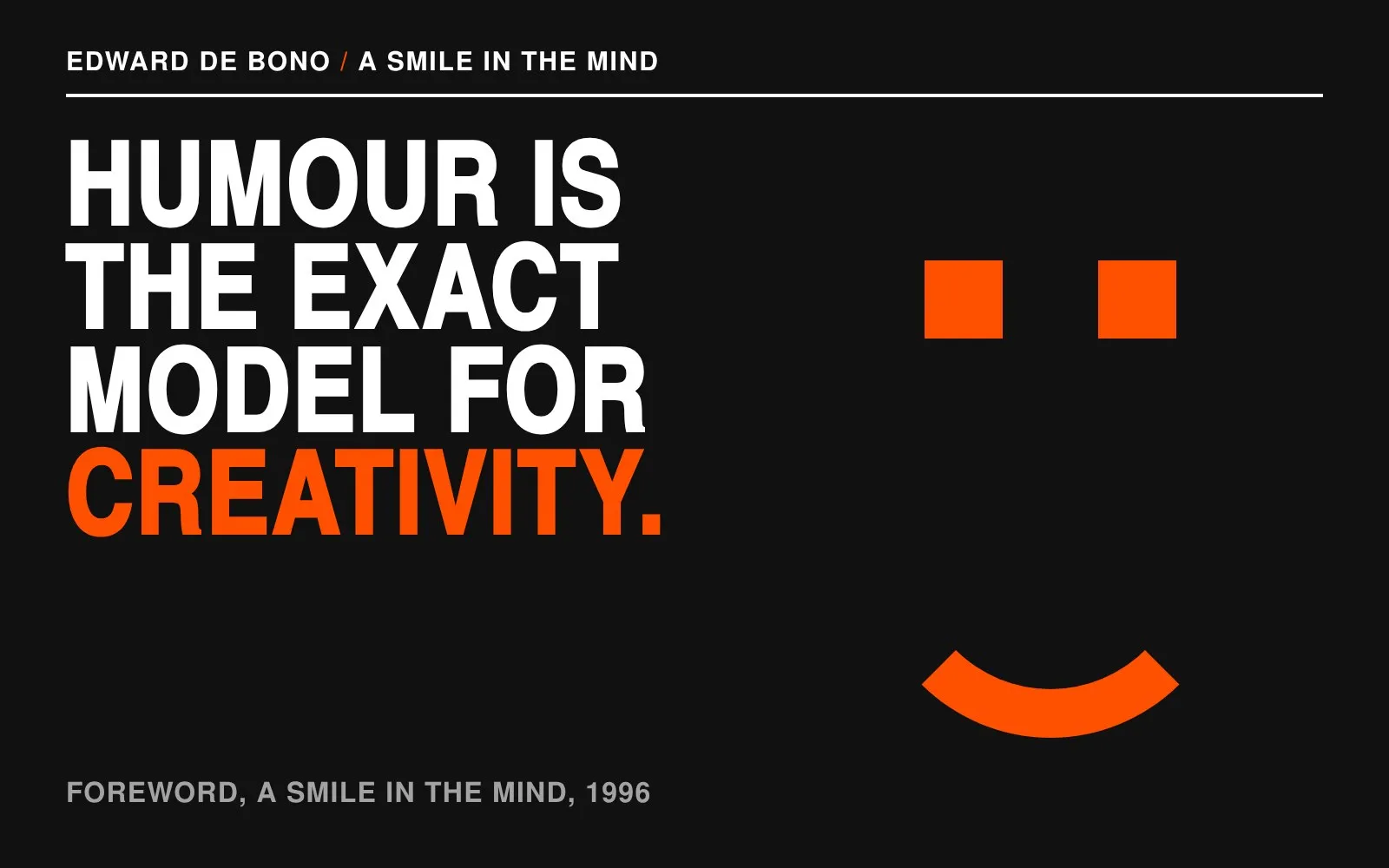
“Humour is the exact model for creativity.”
Think about how a joke works. It leads you down one path, then suddenly flips you onto another. For a split second you’re lost. Then it clicks, and you laugh.
De Bono’s point is that a creative idea works exactly the same way. It reaches somewhere you couldn’t get to by ordinary step-by-step logic. Then, once you’re there, it makes perfect sense.
That little click is the smile in the mind.
Why it matters for a brand
Witty design isn’t the same as jokey design. Nobody’s asking you to put puns on your van. (Please don’t put puns on your van.)
It’s about leaving a small gap for the customer to close. Fletcher’s V&A logo, where the ampersand doubles as part of the A. The FedEx arrow hiding between the E and the x. Ideas you have to finish yourself.
And when someone finishes an idea, they own a bit of it. They remember it. They point it out to friends. That’s worth more than any amount of shouting.
What to try
- Leave something out. Ask what the customer could work out for themselves. Let them.
- Look for the double meaning. In your name, your product, your town. There’s often a smile hiding in plain sight.
- Test it on someone. If they get it and grin, keep it. If they need it explained, bin it.
- Keep it kind. The best wit makes the viewer feel clever, never stupid.
Five people, one lesson
Scher: be noticed. Olins: be believed. Johnson: join the thinking to the look. Fletcher: keep your eyes open. De Bono: make them smile, and they’ll remember you.
None of that needs a big budget. It needs a bit of thought, and somebody willing to look at the problem sideways.
That’s what we’re here for. Let’s have a chat.
We help small businesses across Colchester and Essex with brand, web design, photography and marketing. Let's talk.