Wally Olins and why your brand is everything you do.
 By Nick Ridley ·
Last time I wrote about Paula Scher, the designer who makes type shout. This time it’s someone who barely drew a thing, and changed my trade just as much.
Wally Olins.
If Scher is about how a brand looks, Olins is about everything else. And “everything else” turns out to be most of it.
Who he was
Olins was born in London in 1930 and died in 2014, aged 83. In 1965 he set up Wolff Olins with designer Michael Wolff. It’s widely seen as Britain’s first proper design consultancy, in the sense we’d recognise now: not just a studio making nice things, but people helping organisations work out who they are.
He was hard to miss. Black-rimmed glasses, bow tie, opinions. Lots of opinions.
The work is all over British life. Prudential in 1986. BT in 1991, with the prancing piper that plenty of people hated at the time. Orange in 1994, a mobile phone network named after a colour. In 2001 he went on to co-found Saffron Brand Consultants, and spent his last years advising companies and even countries on how to present themselves.
The big idea
Before Olins, “corporate identity” mostly meant a logo and a rulebook about where to put it.
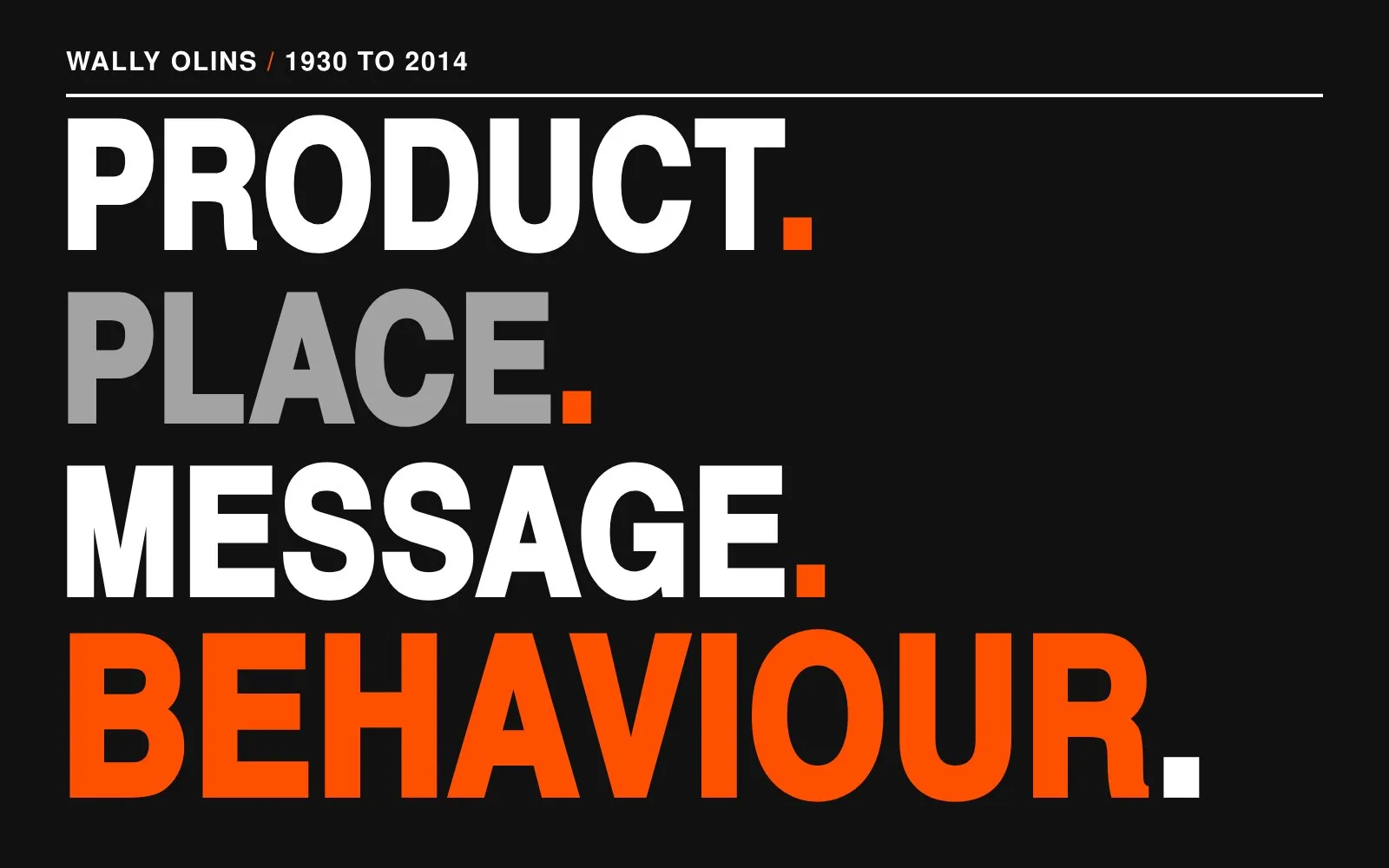
He argued it was much bigger than that. In books like The Corporate Personality (1978) and Corporate Identity (1989), he made the case that an organisation shows who it is in four places:
- What it makes or sells. The product or service itself.
- Where it does it. The shop, the office, the van, the website.
- What it says. Every leaflet, advert, email and invoice.
- How it behaves. How staff treat people. How the phone gets answered. How a complaint gets handled.
The logo touches all four. But it’s only a small part of any of them.
That fourth one is the killer. You can spend a fortune on a brand and have it undone by one grumpy phone call.
He told people the truth
Olins was famous for saying exactly what he thought. In his own words: “I simply tell my clients the truth as I see it, without too much gloss or varnish.”
He was rude about his own industry too. He once called the big design consultancies “machines devised to produce mediocre rubbish”. The designer Michael Johnson, who knew him well, remembers him enjoying a good argument so much he’d heckle speakers from the front row.
I love that. Branding has a habit of disappearing up its own jargon. Olins kept dragging it back to plain questions. Who are you? What do you stand for? Does what you actually do match what you say?
What it means for a small business
You don’t need Wolff Olins to use Olins’ thinking. In some ways it’s easier for a small business, because there are fewer people to get in line.
Try his four places on your own business this week:
- Product. Does what you sell feel like the same company that’s on your website?
- Place. Walk up to your premises, or open your website on your phone, as if you’ve never seen it before. What does it tell you?
- Message. Read your last five emails to customers. Do they sound like one business, or five different people?
- Behaviour. Ring your own number. Seriously. How does it feel?
If one of those is out of step with the others, that’s where your brand is leaking. And no new logo will fix it.
Scher and Olins together
Put the two side by side and you’ve got most of what good branding is.
Scher shows you how to be noticed: big, brave, unmistakable. Olins shows you how to be believed: consistent, honest, the same on a Tuesday afternoon as in the launch campaign.
Noticed and believed. Most small businesses are one or the other. The good ones are both.
If you’d like a fresh pair of eyes on all four of Olins’ places, our AI Brand Audit is a good place to start. Or just come and have a chat. I’ll tell you the truth as I see it. Without too much varnish.
We help small businesses across Colchester and Essex with brand, web design, photography and marketing. Let's talk.